
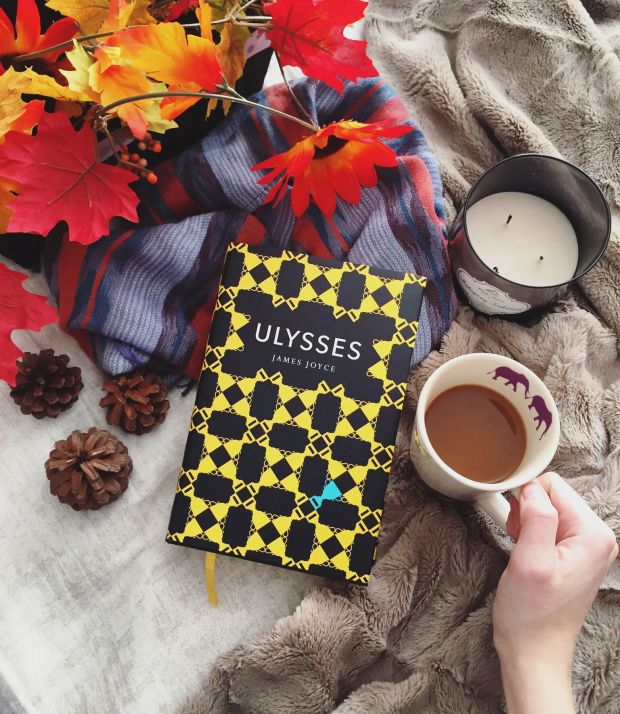
Title: Ulysses
Author: James Joyce
Genre: Classic, Modernist
Publisher: Indigo Library
Format: Hardcover
Pages: 842
Rating: 3.5/5 stars
Synopsis (Goodreads):
Ulysses has been labeled dirty, blasphemous & unreadable. In a 1933 court decision, Judge John M. Woolsey declared it an emetic book–tho he found it sufficiently unobscene to allow its importation into the USA–& Virginia Woolf was moved to decry Joyce’s “cloacal obsession.” None of these adjectives, however, do the slightest justice to the novel. To this day it remains the modernist masterpiece, in which the author takes both Celtic lyricism & vulgarity to splendid extremes. It’s funny, sorrowful, even (in a close-focus sort of way) suspenseful. Despite the exegetical industry that has sprung up in the last 75 years, Ulysses is also a compulsively readable book. Even the verbal vaudeville of the final chapters can be navigated with relative ease, as long as you’re willing to be buffeted, tickled, challenged & (occasionally) vexed by Joyce’s sheer command of English. Among other things, a novel is simply a long story. The 1st question about any story is: What happens?. In this case, the answer might be Everything. Wm Blake, one of literature’s sublime myopics, saw the universe in a grain of sand. Joyce saw it in Dublin, on 6/16/1904, a day distinguished by its utter normality. Two characters, Stephen Dedalus & Leopold Bloom, go about their separate business, crossing paths with a gallery of indelible Dubliners. We watch them teach, eat, stroll the streets, argue & (in Bloom’s case) masturbate. Thanks to the stream-of-consciousness technique–which suggests no mere stream but an impossibly deep, swift-running river–we’re privy to their thoughts, emotions & memories. The result? Almost every variety of experience is crammed into the accordian folds of a single day, which makes Ulysses not just an experimental work but the very last word in realism. Both characters add their glorious intonations to the music of the prose. Dedalus’ accent–that of a freelance esthetician, who dabbles here & there in what we might call Early Yeats Lite–will be familiar to readers of Portrait of an Artist as a Young Man. But Bloom’s wistful sensualism (& naive curiosity) is something else entirely. Seen thru his eyes, a rundown corner of a graveyard is a figure for hope & hopelessness, mortality & dogged survival: “Mr Bloom walked unheeded along his grove by saddened angels, crosses, broken pillars, family vaults, stone hopes praying with upcast eyes, old Ireland’s hearts & hands. More sensible to spend the money on some charity for the living. Pray for the repose of the soul of. Does anybody really?”–James Marcus
Review:
This book is both a masterpiece and really, really weird. I don’t know how else to describe it. The book is considered to be a modernist classic, and a highly moving and intellectual novel, but it was definitely hard to follow as it does not follow the typical writing contentions that you would expect; for example, quotations used when a character is speaking. It was difficult to follow the dialogue as it was hard to figure out who was speaking.
The book is named Ulysses because it is supposed to coincide with Homer’s the Odyssey. You may question as to why a day in the life of an average Irish citizen might be compared to Homer’s epic poem, and I answer that question by saying that Joyce wanted to open up the minds of his characters in an epic way, and show that one day can have many adventures. There are two main characters that the book follows: Leonard Bloom and Stephen Dedalus. Bloom has many adventures during the day, including going to a funeral, trying to get an ad accepted by the paper, visiting the shore where he does something sexually inappropriate in public, visits a pregnant woman in the hospital, and then taking care of a drunk Dedalus. Stephen is more of the intellectual types, who is a teacher, and then later gives a talk on his theories on Shakespeare. Both very different, yet similar in that they are unsatisfied with their lives, and they want to improve.
I definitely enjoyed this book, but I would only recommend it if you enjoy reading obscure classics without much structure! Happy reading bookworms!


Great review. I read this book a few years ago and much if it went over my head until I listened to a radio adaptation, set in real time on ‘Bloomsday’. It brought a lot if it to life for me! Bronte
LikeLike
Oh wow great idea! I should listen to the radio adaptation! It might help me connect to the book more! Thanks for the suggestion.
LikeLiked by 1 person