
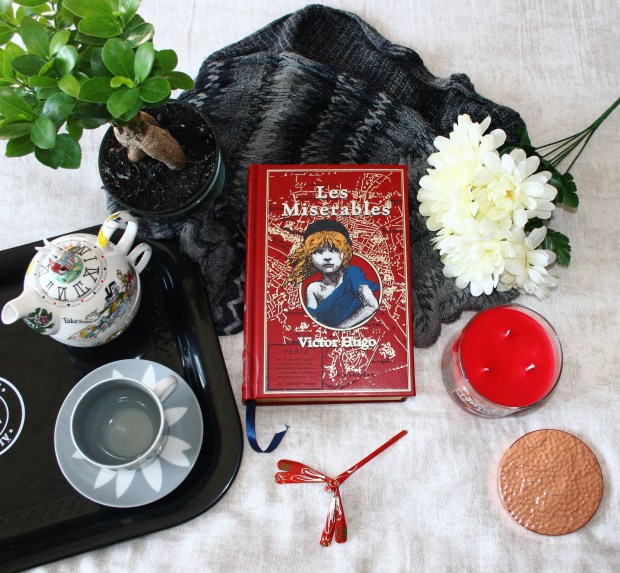
 Title: Les Miserables
Author: Victor Hugo
Genre: Classics
Publisher: Canterbury Classics
Format: Leather Bound
Pages: 1264
Rating: 5/5
Synopsis (from Goodreads):
“So long as ignorance and poverty exist on earth, books of the nature of Les Misérables cannot fail to be of use,” says Victor Hugo in the preface of his famous novel. Certainly, Les Misérables is French history recounted through the personal stories of its main characters. The tale offers philosophical insight on the good deeds that can happen even amid ignorance and poverty. This handsome leather-bound volume is a beautiful addition to any classic literature library with specially designed endpapers, gilded edges, and a ribbon bookmark so you never lose your place.
Review:
Oh my, how I loved this book! There are so many things to love, that I honestly don’t know where to begin.
Maybe I should begin with the setting. The book takes place after the Napoleonic Wars (so post 1815 Battle of Waterloo) and there were so many important things happening during this time. The book culminates with the June 1832 uprising, and Hugo does a fantastic job of highlighting what led up to the uprising. He goes into great detail to describe the historical and the philosophical points of the novel. He writes about why the people of France have revolutionary fervor, why the people believed in liberty, equality, and fraternity, universal manhood suffrage, and the rights of the citizen (notice how there were no female rights at this time, which I will get into later.) He also devoted a whole section describing the Battle of Waterloo for the reader. What amazed me was Hugo made sure that the reader was immersed in his tale, and in the time the tale took place. Published first in 1862, many people at the time were reflecting back to the French Revolution and to the Reign of Terror of 1793, and why France had suffered similar uprisings in 1830, 1832, and 1848. Hugo argues that it was because the rights of the citizens could not be ignored, and the people of France believed that they did not endure years of revolution just to have the monarchy put back in place.
One quote that struck me was “Citizens, the nineteenth century is great, but the twentieth century will be happy.” The people of France believed they were working towards creating a society where all men were free and happy. Yet looking back, no one could have predicted the First and the Second World Wars at the time.
Now to move on to the characters. Obviously Jean Valjean is a favourite, because how can you not love such a loving man who did everything he could for Cosette. He personifies how corrupt French society was at the time, and how he was sent to the galleys for stealing bread to feed his family. The rights of women are represented through Fantine. She fell in love and had a child out of wedlock as a result. Forced to care for this child on her own, she was reduced to pitiless circumstances, which showed that women had a rough time during the early nineteenth century, since the revolution fought for the Rights of Man. But Valjean’s devotion to Fantine and for caring for her child shows that he believed that her lot in life was too hard to imagine.
My other favourite characters are Cosette and Marius. Cosette because she was Hugo’s personification of purity, and Marius because he represented the beliefs that all young revolutionists at the time believed. He believed that he and his comrade’s would have to sacrifice to overthrow the monarchy in order to produce a better and more equal society; a belief that explains the many uprisings in France and Europe at that time. There are many other characters in the novel that play some importance to the story, but I will not go into them, as I would be repeating myself.
I will leave off my review with saying that through Cosette, Hugo was pushing forth the idea of womanly innocence and virtue, and that women should be given the opportunity to display such virtue. Unlike her mother, Cosette was given the opportunity to grow up virtuous, and this opportunity is what all women should have, according to Hugo. When describing the love between Cosette and Marius, I could not help but chuckle at a few explanations. One was “For him, Cosette was a perfume and not a woman. He inhaled her.” What a way to describe nineteenth century love haha.
Feel free to comment or email me if you have any thoughts or questions on the book! Thank you for reading!

 Hooked to Books
The stuff is really appealing
LikeLike
I also love this book and decided to read it because of my passionate and obsessive love of the musical. It is such a tough read because the storyline is so complex. To me, it is such an inspirational, hopeful, revolutionary, and passionate book. Even though it is heartbreaking, it still tales this wonderful tale of sacrifice, hope, love, compassion, forgiveness, humanity, and redemption.
Reading the unabridged book summer of 2015 made me fall in love with the musical even more. Even though there are characterization differences, I still love both. I even finished it in less than one summer. It really helped using my knowledge of the musical to understand the book.
LikeLike
I agree! I saw the musical before I read the book, and it really helped to understand all the characters and the context of the story!
LikeLike
While reading, I marked important characters and even wrote in songs
LikeLike
I sang the songs in my head as I was reading certain passages!
LikeLike