
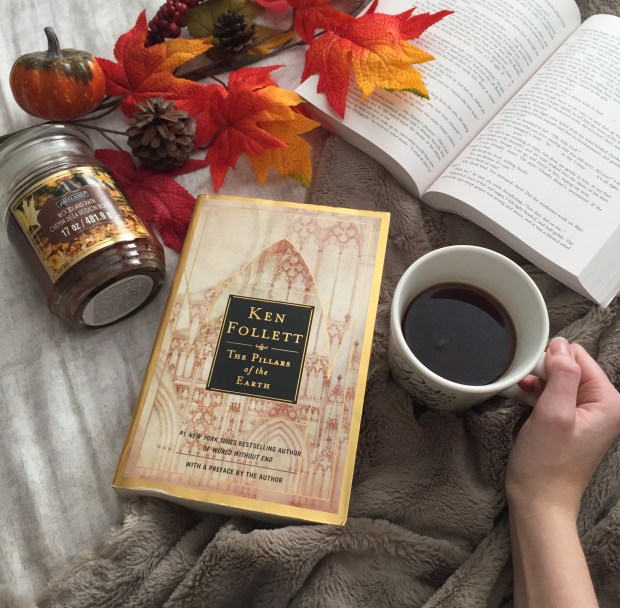
Book: The Pillars of the Earth
Author: Ken Follett
Genre: Historical Fiction
Publisher: NAL Trade
Format: Paperback
Pages: 973
Rating: 5/5 stars
*Warning: mature content. Parents please be advised.*
Synopsis (Goodreads):
Everything readers expect from Follett is here: intrigue, fast-paced action, and passionate romance. But what makes The Pillars of the Earth extraordinary is the time—the twelfth century; the place—feudal England; and the subject—the building of a glorious cathedral. Follett has re-created the crude, flamboyant England of the Middle Ages in every detail. The vast forests, the walled towns, the castles, and the monasteries become a familiar landscape. Against this richly imagined and intricately interwoven backdrop, filled with the ravages of war and the rhythms of daily life, the master storyteller draws the reader irresistibly into the intertwined lives of his characters—into their dreams, their labors, and their loves: Tom, the master builder; Aliena, the ravishingly beautiful noblewoman; Philip, the prior of Kingsbridge; Jack, the artist in stone; and Ellen, the woman of the forest who casts a terrifying curse. From humble stonemason to imperious monarch, each character is brought vividly to life.
The building of the cathedral, with the almost eerie artistry of the unschooled stonemasons, is the center of the drama. Around the site of the construction, Follett weaves a story of betrayal, revenge, and love, which begins with the public hanging of an innocent man and ends with the humiliation of a king.
At once a sensuous and endearing love story and an epic that shines with the fierce spirit of a passionate age, The Pillars of the Earth is without a doubt Ken Follett’s masterpiece.
Review:
So this is the kind of book that sends chills down your spine right from the beginning author’s note about his love for history and cathedrals. Follett knows how to develop a setting, characters, and plot so that they all fit and intertwine perfectly.
The story is set during a civil war that is waging in England during the 1100s. King Henry died with no legitimate male heirs, so before he died, he tried to get the Barons to swear fealty to his daughter, Matilda. However, many Barons did not want to pledge allegience to a woman, so many turned to a male relative, Stephen. Thus ensued a bloody war that lasted many years and tore many families and towns apart. The book does a great job of explaining the history behind these events, and as a reader with a love of history, I loved being submerged in the medieval Europe world. You are able to learn so much about the time period, how people lived their lives, how the social structure worked, and you even got to learn about significant historical events, such as the feud between King Henry II and Thomas Beckett, Archbishop of Canterbury. The book is a historical fiction classic!
There are many great characters in this book, but my favourite is Aliena. Her character was able to develop so well. She started off the book being a young Earl’s daughter, to becoming a poor beggar. She has to use her wit to help her and her younger brother survive. This is especially difficult being a woman in the middle ages. She eventually becomes a successful merchant, and she develops into a strong and witty character. She learns a lot about herself and a lot about the world around her.
Other interesting characters include Tom Builder and Jack Jackson. Tom was a mason, which means he built buildings. His dream was to build a giant cathedral. Back then, it was common to have a last name that denoted your work, or whose son you were, or from what area you are from. Ex: Richard of Kingsbridge was from Kingsbridge, so that was his last name. Jack was the son of Jack, hence his last name, Jackson. Jack was another interesting character in that he was raised in a forest, yet was quite an intellectual who could tell stories like his father, who was a French jongleur (traveling story teller).
One of the main aspects of the book is the architecture of the time period. We get to learn about arches and flying buttresses, and how they laid the stone and measured the area and materials. Follett mentioned in the author’s introductory note that he had always been fascinated by cathedrals, and how he had always wanted to write about the building of these beautiful buildings. The book follows the building of Kingsbridge cathedral, and how this affected the townspeople, the priory, and the builders themselves. The way Follett weaved the story through the development of the cathedral is truly brilliant, and I recommend this book highly.
If you have any comments or questions, feel free to comment or send me an email!
Happy reading!

 Hooked to Books